
AI, practical skills & better ways to workENGLISH EDITION
Stay curious. Make something useful.
Auratro
Auratro/AI News

Cloudflare says bots moved providers after the Yandex disruption

Its 14 October analysis found matching request patterns elsewhere. A traffic drop at one network did not establish that the activity had stopped.
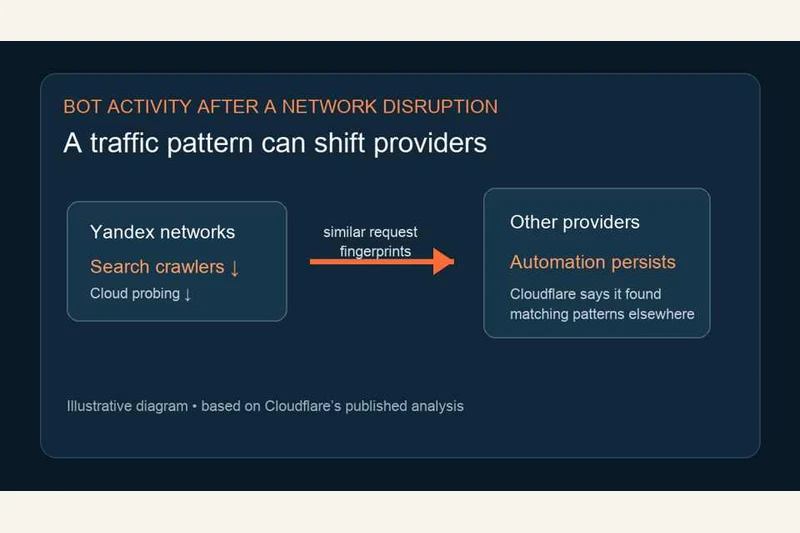
Auratro's explanatory diagram shows falling activity at Yandex networks and similar request fingerprints at other providers; it is not a measured traffic chart.
Illustrative photo · Auratro / Unsplash
In this article

Cloudflare says a sharp decline in traffic from Yandex networks did not mean that all the automated activity had disappeared. In an analysis published on 14 October, it reported finding matching request patterns at other hosting providers.

The company distinguished verified search crawling from scanning and probing associated with cloud-hosted traffic. Some requests it tracked elsewhere shared technical characteristics, including TLS fingerprints, unusual paths and headers, and custom user-agent strings.

A hosting change can hide the same pattern

For website operators, the useful distinction is between a network going quiet and an activity ending. Cloudflare's account describes the former without establishing the latter.

What the evidence cannot tell us

The findings reflect traffic visible to Cloudflare, not a complete census of the internet. Similar fingerprints are investigative clues; they do not establish who operated every request or its purpose.

Auratro has not independently reproduced the analysis. The accompanying original diagram explains the reported relationship; it is not a data chart or a photograph of an attack.

Sources & further reading

Cloudflare's 14 October 2026 analysis of Yandex traffic and bot migration

From Auratro Editorial

Our articles help you explore AI and build practical skills. For a correction or a question, contact us. Contact

Keep reading

NEXT STORY Tools

Browser Use has three routes to an AI browser agent. They are not the same service.

The Python library, CLI and hosted API put different parts of the workflow under your control. Free source code does not mean free model or cloud usage.

Auratro EditorialOpen this article
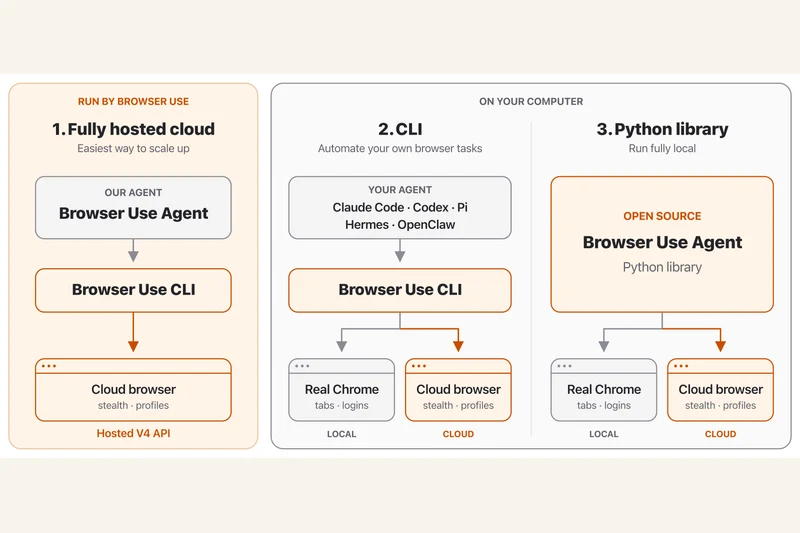
Official Browser Use diagram comparing the hosted cloud agent, CLI and Python library with local and cloud browser connections.
Browser Use contributors / Gregor Zunic (MIT); original project diagram, rasterized from SVG

Browser Use's current repository separates three ways to automate browser tasks: a fully hosted cloud service, a CLI for an existing agent and an open-source Python library for applications.

The library lets a developer connect an agent to a model and browser. The documented tasks include opening pages, interacting with forms and extracting information. Those are described capabilities, not a guarantee that an agent will complete any particular website task.

A cloud browser is not a hosted agent

The CLI and Python library can work with local or cloud browsers. A cloud browser hosts the browser itself; the fully hosted API also runs the agent. Choosing between them changes what the developer must operate.

Check the bill before the demo

The Python library is MIT-licensed. Model inference and hosted browser services can still incur separate charges. Connecting a logged-in profile also deserves care because it gives the workflow access to that session.

This documentation-based explainer was checked on 16 October 2026. Auratro has not independently run the workflow or verified the project's benchmark claims.

Sources & further readingbrowser-use/browser-use official repository and documentationProject MIT licence and copyright notice
NEXT STORY Tools

Before your coding agent writes code, Spec Kit gives it a plan

GitHub's open-source toolkit separates requirements, planning and implementation—and also offers optional bug-fixing and idea-assessment processes.

Auratro EditorialOpen this article
Official Spec Kit project mark showing a green seedling on a purple and pink background.
GitHub, Inc. / Spec Kit project (MIT); project mark shown for identification

GitHub's Spec Kit gives AI coding agents a structured workflow instead of one long instruction. Its current repository describes a process that carries a specification into a technical plan, actionable tasks and implementation review.

That makes the project relevant to developers who want something inspectable between asking for a feature and accepting generated code. The written requirements and task list give reviewers a place to check whether the agent understood the request.

More than one starting point

Specification-driven development is included in the core toolkit. Bug fixing and idea assessment are separate, optional extensions; the repository does not present them as mandatory stages for every project.

Community catalogs add extensions, presets and workflows. GitHub explicitly warns that a catalog listing is not an audit or endorsement, so inspect unfamiliar components before running them.

What this article establishes

The repository lists Python 3.11 or later, uv and a supported coding agent as prerequisites. This is a documentation-based tool explainer, checked on 16 October 2026—not a new-launch report or an independently tested claim that Spec Kit improves code quality.

Sources & further readinggithub/spec-kit official repository and documentationProject MIT licence and copyright notice