
Practical AI tutorials, tool guides and workflowsENGLISH EDITION
Stay curious. Make something useful.
Auratro

Tutorials

Keep reading

NEXT STORY Tutorials

How to proofread and tighten writing with AI while keeping your voice

Use separate editing passes, a reusable prompt and a side-by-side check to keep control of your words and meaning.
Auratro EditorialOpen this article
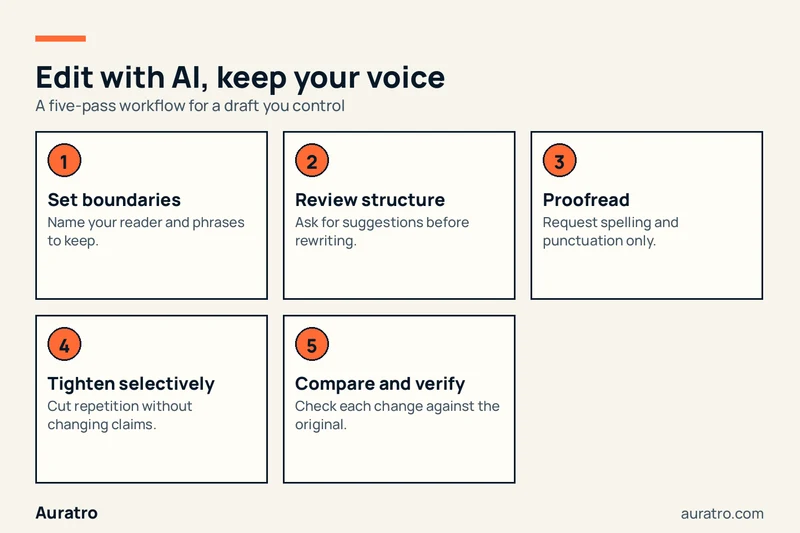
Five steps for editing writing with AI, from setting boundaries to comparing changes
Diagram by Auratro

A polished rewrite can be less useful than the messy original if it changes a promise or removes the phrase that sounds like you. To proofread with AI while keeping your voice, ask for a narrow edit, inspect the proposed changes and make the final choices yourself. Work on structure, errors and concision in separate passes.

This method adapts guidance from Google and Anthropic into a reusable editing routine. It works with a text-based AI assistant; the examples below are instructions you can adapt, not a record of a product test. Interfaces and data policies vary, so check your chosen tool's current guidance before sharing a draft.

Decide what must stay yours

Voice is the pattern of choices that makes a piece sound like its writer: word choice, rhythm, level of formality and the way it addresses readers. Choose two or three traits you actually want to keep, such as conversational sentences and a dry aside. Mark a phrase that carries your meaning or sounds distinctly like you. These are editing instructions, not a guarantee the assistant will follow them.

Tell the assistant who will read the piece and what you want the reader to do. Google's technical writing guidance recommends identifying an audience, document type and goal in a prompt. Anthropic's Claude Opus 4.8 guidance suggests specifying a desired tone and revisiting style instructions when model behaviour changes. A short sample of your own writing can demonstrate the tone you want, provided you have permission to share it.

Keep a separate copy of the original. That gives you a reference when an edit sounds smoother but quietly changes a qualification. If the draft contains private material, remove it or use an approved tool; the chatbot privacy checklist helps you decide what to leave out.

How to edit in five passes

The workflow below is an editorial method built from the sources, not a product-specific menu tutorial. Open a text assistant of your choice and use its normal message field. Google recommends dealing with organisation before grammar and style; its guide also warns that generated responses can contain errors. Apply the following steps to a short section first.

  1. Save an untouched copy of the draft. Identify its audience, purpose and any wording, claims or qualifications that must stay.
  2. Ask for an organisation review. Request a list of confusing transitions or misplaced paragraphs, without a rewrite. Decide which suggestions fit your purpose.
  3. Request a proofreading pass for spelling, punctuation and grammar only. Ask for each proposed correction with its reason, so you can reject a change that is deliberate.
  4. Ask for a separate tightening pass. Request specific cuts to repetition and wordy phrases, while preserving the meaning, tone and marked phrases.
  5. Compare each suggestion with the saved original. Check numbers, names, negations and qualifications, then accept, revise or reject the change yourself.

For a long document, repeat the passes on manageable sections and then read the whole piece for continuity. A paragraph can make sense alone while a transition fails in context. The five-part prompt template offers another way to spell out the task, context and desired response.

A prompt you can adapt

Use this example after replacing the bracketed parts. It asks for suggestions rather than automatic acceptance, and separates the text to edit from the instructions. Anthropic suggests specifying a desired tone for Claude Opus 4.8; Google suggests constraining an assistant to information supplied by the writer. Neither instruction guarantees compliance, so review the result.

Help me edit a [document type] for [audience]. The reader should [goal].

My voice is [two concrete traits]. Keep these phrases: [phrases]. Preserve all claims and qualifications. Do not add facts.

First, list up to three structural concerns without rewriting. Then list spelling, grammar and punctuation suggestions separately. Finally, suggest specific cuts to repetition. For each suggestion, show the original, the proposed change and a brief reason. Flag anything whose meaning is unclear instead of guessing.

Draft: [paste a short, shareable section] ```

The prompt groups three requests in one message, but you can send them separately if the response mixes them together. For a strictly mechanical proofread, remove the structure and tightening requests. If a suggested edit sounds unlike you, describe the problem precisely: for example, ask to keep contractions or retain the original sentence order.

Worked example: shorter without a stronger claim

The following passage and edits are illustrative examples written by Auratro, not recorded answers from an AI tool. Imagine a community organiser writing to volunteers: ‘We are hoping to possibly open the garden on Saturday, if the weather allows us to do so.’ The message has a clear condition and expresses a hope, not a confirmed opening.

A useful proposed cut is: ‘We hope to open the garden on Saturday, weather permitting.’ It removes extra words while keeping the hope and the weather condition. A risky edit would be: ‘The garden opens on Saturday.’ That version drops both uncertainties. It is shorter, but it makes a different promise. Reject it unless you have independently confirmed the opening.

Now consider voice. If the writer normally says ‘if the weather holds’, that phrase may feel more natural than ‘weather permitting’. A possible final sentence is: ‘We hope to open the garden on Saturday, if the weather holds.’ The author chooses it; the assistant's phrasing is only a proposal. Google’s short-sentence guidance recommends removing unnecessary words and focusing sentences on one idea, but brevity is not a reason to discard meaning.

Common mistakes to catch

A request to ‘make this professional’ leaves the desired tone open to interpretation. Name the intended audience and give a concrete description instead, such as ‘friendly and direct, with contractions’. Also avoid asking for a complete rewrite when you only need corrections: request a list of changes so you can inspect the original wording beside each suggestion.

Watch for changes to small words. ‘May’ can become ‘will’; ‘some’ can become ‘all’; a negative can disappear. Check any quotation against its source and every number against the record from which it came. Google warns that model responses can introduce mistakes and advises checking both factual errors and passages that do not feel right. A fluent sentence is not evidence that its claim is true.

Do not treat every long sentence as an error. A deliberate rhythm, qualification or example may earn its space. Google's guidance is aimed at technical writing and suggests shortening sentences and removing unnecessary words; a personal essay or fictional dialogue may need different rhythms. Read the edited passage aloud and restore wording that better serves the reader.

Limits and what to check

A prompt cannot ensure the assistant preserves voice, keeps facts unchanged or identifies every error. Its suggestions are a starting point for judgement. Compare the final version with the saved original, verify factual claims against reliable sources and read the whole piece for missing context. Ask a human reader for a second opinion when the stakes or audience warrant it.

Privacy controls, retention policies, available features and interfaces differ across services and plans and can change. Check the official documentation for the service and account you use before submitting material. If you cannot share a document, apply the same checklist yourself to an anonymised passage or keep the editing offline.
Sources & further readingUsing large language models in technical writingPrompting Claude Opus 4.8Short sentences
NEXT STORY Tutorials

Build a weekly study plan with AI in 20 minutes

Turn your actual availability and course topics into a draft timetable, then check its arithmetic and revise it when life changes.

Auratro EditorialOpen this article
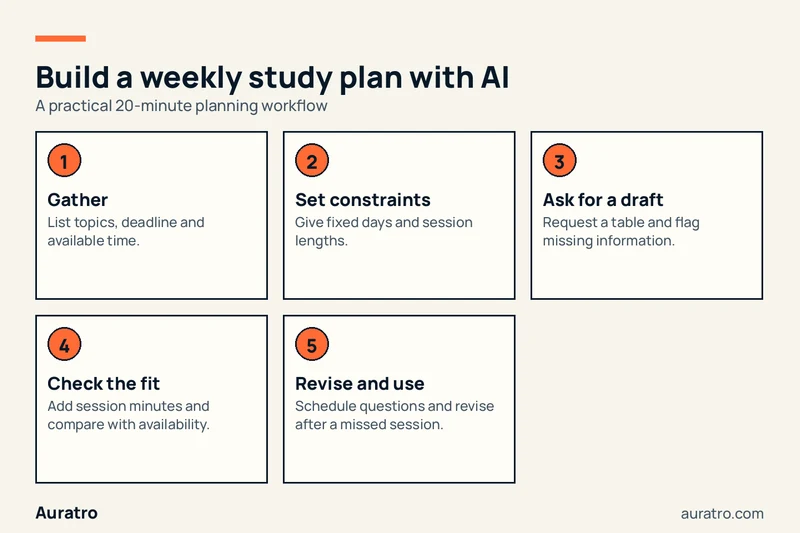
Five-step diagram for gathering study constraints, drafting a timetable and checking it
Diagram by Auratro

A timetable that assigns two hours on a day when you only have 30 minutes is not a study plan you can follow. An AI assistant can turn a list of topics and available slots into a first draft, but you need to supply the constraints and check the result. This method uses a 20-minute planning target; it is not a promise that every course can be planned in that time.

This approach works with an ordinary chat assistant. Optional ChatGPT Study instructions below follow OpenAI's help page checked on 26 November 2026; menu layouts and availability can change, so consult the official page for your device. Our planning example is invented to show the arithmetic, not a recorded assistant response.

Gather the inputs before opening a chat

Start with the syllabus or the list of material your teacher has actually assigned. Write down the assessment date, the topics in scope and any work due before then. Next, list realistic study windows in minutes: include days when you cannot study. Separate a fixed deadline from a preference, such as wanting to finish a chapter early. If a topic has prerequisites, note them so the draft can put them in a useful order.

You do not have to share an entire document. Paste a short topic list if that is enough, and leave out personal details or material you are not permitted to share. OpenAI's Study mode guidance suggests giving the subject, level, goal, deadline and relevant course materials. Its general prompt advice also recommends a clear task and necessary context. The five-part AI prompt gives another way to organise those details.

Make the first draft in 20 minutes

Use the timings below as a planning budget, not a measured guarantee. If your materials need longer to gather, take longer. Your aim is to leave time for a human check rather than spending the whole allowance generating a polished table. These steps use a regular ChatGPT conversation as one documented example; the prompt itself can be adapted to another assistant.

  1. Spend 4 minutes listing the course topics, deadline, available days and minutes, and any fixed commitments.
  2. Spend 2 minutes opening a regular ChatGPT conversation. On the web, type @study in the message composer, or select + and search for study, then select Study. This optional mode can ask questions and help review materials.
  3. Spend 4 minutes adapting the example prompt below. Replace the sample constraints with your own and ask for a day-by-day table.
  4. Spend 4 minutes checking the proposed days, minutes and topic coverage against your list. Add the minutes yourself; mark any assumption that needs an answer.
  5. Spend 4 minutes requesting corrections. Name each conflict and ask the assistant to preserve the unchanged constraints.
  6. Spend 2 minutes copying the revised sessions into your own calendar or notes, then set a time to review the plan after your first sessions.

As of 26 November 2026, OpenAI says Study is selected in a regular conversation and is unavailable in Temporary Chats, GPTs and Projects. Its help page says device menus can vary. Study is optional for this planning exercise: the same constraints can be entered as text in an ordinary conversation. If you use a different assistant, follow its own interface and rules.

A prompt you can adapt

A prompt is the instruction you give an assistant. OpenAI recommends dividing complex requests into smaller tasks and refining the response. Anthropic's evaluation guidance recommends defining specific, measurable success criteria. This example puts both ideas into practice: it asks for a usable table, makes the limits visible and tells the assistant to identify missing information rather than silently invent it.

Help me draft a study plan for the next seven days.
Subject and level: [subject and level].
Assessment or deadline: [date and format].
Topics to cover, in course order: [list].
Available time: [days and minutes, including unavailable days].
Topics I find difficult: [list or unknown].
Return a table with day, minutes, topic and a specific activity.
Stay within each day's available minutes. Include a short self-check activity in each session. List assumptions and missing information separately. If everything cannot fit, say what is left out instead of adding time.

Replace the brackets before sending. For a reading course, a specific activity might be explaining an argument from memory and then checking the reading. For a maths course, it might be solving a particular type of problem and comparing the steps with a worked solution. Specify the kind of activity your course requires; a generic instruction to 'study chapter three' leaves too much to decide when the session starts.

Check a worked example

Suppose a student has a biology quiz next week and lists three topics: cells, enzymes and transport. Their available slots are Monday 30 minutes, Wednesday 45 minutes and Saturday 45 minutes. That is 120 minutes in total. Below, the table is an illustrative plan written by Auratro, not a recorded answer from an assistant. That exact division is a planning choice, not a claim that each topic requires that amount of time.

DayMinutesTopic and activity
Monday30Cells: review notes, then label a diagram from memory.
Wednesday45Enzymes: work through course questions and check the answers.
Saturday45Transport: explain the process, then revisit missed questions.

Those daily totals match the three available slots: 30 + 45 + 45 = 120 minutes. That check does not establish that the content is correct or sufficient for the quiz. Compare the topics with the syllabus and adjust the split if the course places greater emphasis on one area. If the assistant adds a Thursday session or assumes a different deadline, ask it to repair those specific errors.

Turn the timetable into useful sessions

A table says when to work; a concrete task says what to do when the time arrives. Ask the assistant to turn each topic into a short activity and a question you answer before looking at your notes. OpenAI says Study mode can create practice questions, ask open-ended questions and give feedback. Its help page also notes that the mode can make mistakes, so compare the question and feedback with your course materials.

At the end of a session, record what you completed and what remains unclear. Then give the assistant a narrow update: 'Wednesday took longer than expected; I finished the first two enzyme questions. Keep Saturday at 45 minutes and suggest what to prioritise.' OpenAI's prompt guidance recommends iterative refinement. Keep the original constraints in the follow-up so that a revision does not quietly consume time you do not have.

If the plan is too full, ask for an explicit trade-off: which listed task is deferred, and where will it go? You decide whether the trade-off matches the course. An assistant can arrange tasks but cannot know an unshared class announcement or judge your progress from a timetable alone. The AI hallucination checking guide offers a process for checking generated claims against reliable material.

Limits and what to check

The 20-minute breakdown is a suggested way to allocate planning time, not a study prescription or a guarantee of a particular result. An assistant may misread a file, omit a topic, invent a requirement or produce incorrect practice answers. Check the final schedule against the actual syllabus, assessment instructions and your calendar; check substantive answers against course materials or ask your teacher. A plan cannot replace time spent studying.

OpenAI says Study mode follows the applicable ChatGPT plan and message limits, and uploads depend on what is available in the chat. Features and menus can differ by device, account and version; check the official Study mode page for current details. Follow your institution's rules for AI use, particularly for graded work, and share only material you are authorised to provide.

Sources & further readingHow do I create a good prompt for an AI model?Define success criteria and build evaluationsUsing study mode in ChatGPT